Aquapolis
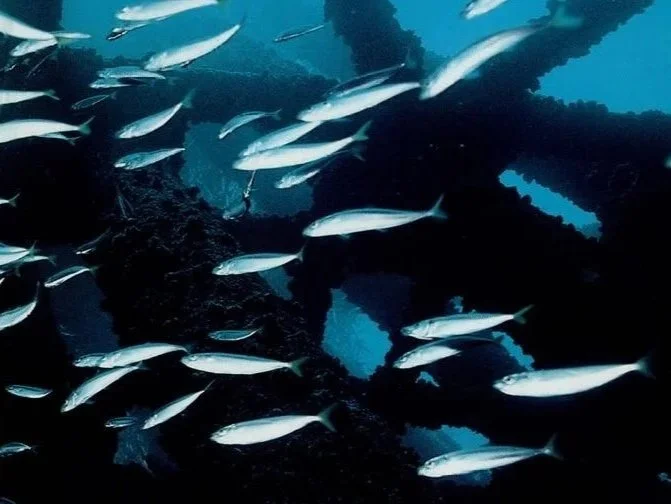
Image: Stephen Myers, Texas Parks & Wildlife, May 1992. Toppled oil platforms create marine habitats.
In 1975, Japan floated a steel city off Okinawa to show the world its future, and a high school band from Houston came to play.
Splash
In the summer of 1975, a stage band of teenagers from Kashmere High School in northeast Houston traveled to Japan to play soul, funk and jazz at a world's fair in Okinawa. The fair's centerpiece was a floating city. Of all the footnotes in the history of the future, this spectacle may be my favorite, partly because it was so slight: a short tour's worth of music at a $550 million fair about tomorrow that closed within six months.
The band was the creation of Conrad O. Johnson, a music teacher his students called Prof. In 1967 he saw Otis Redding play and came away convinced that the heat he felt in that room could be taught to teenagers. He pulled the school's stage band toward funk and soul and wrote much of its music himself. Between the late 1960s and 1977, the band won almost every state and national competition it entered, then carried the sound of Kashmere Gardens abroad.
The following spring, engineers from around the world met in the Astrodome, which Houston liked to call the Eighth Wonder of the World, for the Eighth Annual Offshore Technology Conference. Among that year's papers were studies of the floating city the Kashmere students had seen in Okinawa. It was called Aquapolis, and its architect was Kikutake Kiyonori.
The engineers had reason to be interested. Aquapolis was a semi-submersible, a deck carried on columns above hulls that sat below the waves, where the water is calmer, so that the platform moved less than the sea around it. It had the bones of a drilling platform and the manners of a hotel.
This is not an essay about Houston, though Houston often interrupts my writing about the future, as it has interrupted many conversations about the future since 1836. That year the city existed chiefly as a newspaper advertisement, promising a port, a fortune and a cooling sea breeze. The breeze has been a conundrum ever since, so Houston manufactured its own weather, roofed over a stadium to keep it in, and then built a room that astronauts would call from the Moon. A town founded on a piece of paper was the natural place to study one made of steel.
Aquapolis belongs to a small category of emphatically futuristic schemes that escaped the drawing board and became physically real.
It was so large that a new wet dock had to be built for it at the shipyard in Hiroshima, and five tugboats towed it south to the tip of the Motobu Peninsula in northern Okinawa. Its deck ran about 330 feet on each side, and at 105 feet it stood as tall as a ten-story apartment building.
Four submerged hulls held it steady while buoys and anchors let it rise and fall with the swell. Inside were a banquet hall, offices and quarters for a resident staff of forty, a small town at sea. The government's brochure called it "a small first step toward a future of limitless possibilities."
In 2023, Okinawa Television pulled 8mm film of the fair out of its archive, and it plays like a dream the 1970s had about the year 2000. Filmed from a helicopter, Aquapolis is enormous and faintly wobbly, a square cake on a plate of blue water. Crowds shuffle through its steel tunnels and zip along a people mover toward animatronic cartoon fish that blink on and off. For a moment the whole enterprise resembles the most expensive aquarium gift shop in history. But nothing like it had ever been built, and its engineers were finding out, at sea and in public, how a city behaves in weather.
The Okinawa International Ocean Exposition, known as Expo '75, was meant to open in March 1975. The oil crisis kept the future of the ocean waiting four months — the price of oil and the ocean were entangled from the first day. When the gates finally opened in July, thirty-three countries had spread across 250 acres of subtropical land and water, and the theme was a wish: The Sea We Would Like to See.1 At its center floated Aquapolis, 15,000 tons of metaphor about how people might learn to live with the sea.
Watching the footage now, it is hard not to feel that you are looking at someone else's tomorrow. The German historian Reinhart Koselleck gave us a phrase for that feeling, "futures past," the futures that earlier generations expected. In the modern era, he argued, expectation pulled away from experience, and the future stopped looking like a repeat of the past and began to look open and unprecedented. A brochure promising "limitless possibilities" is that modern future in pure form. Koselleck traced futures past mostly through words, and most of them survive only on paper. Aquapolis was built, staffed, visited by millions and then towed away, prompting a question that schemes on paper never have to answer. What part of a future survives its completion?
Float
From here the story drifts: first to the island that hosted the fair, then to the architect's childhood, and then far out to sea, where a long line of people have tried to live beyond the reach of any nation.
The fair was, first of all, a national ceremony staged inside a global ritual. After twenty-seven years of American administration, Okinawa returned to Japanese rule in 1972, and Expo '75 was conceived partly to mark the reversion and partly to narrow the economic gap between Okinawa and the rest of Japan. Vivian Blaxell, a historian of modern Japan, reads the fair as carrying "both a promise and a threat": a display of what the central government could do for Okinawa, and of what it could do to it. The promise delivered motorways, water systems and hotels, but much of the prosperity it advertised never arrived.
Okinawans had lived through the Battle of Okinawa, nearly three decades of foreign rule and a reversion that left most of the American bases in place. Into that history the national government towed a steel city and accessorized the transfer of power: animatronic fish blinking on cue, a people mover, a ride through the latest underwater robot technology, and a stage band of Texas teenagers playing soul beside the East China Sea.
Aquapolis was also a manifesto. Kikutake was born in 1928 in Kurume, on the island of Kyushu, the seventeenth generation of a landowning family whose duties included protecting its tenants from the floods of the Chikugo River. After the war, land reform under the American occupation took the family's property. Decades later, Kikutake told the Dutch architect Rem Koolhaas and the Swiss curator Hans Ulrich Obrist that everything began there. "My architecture was my protest, as a former landlord, against the dismantling of the entire landowning system," he said.
In 1958 he published Marine City, a floating city for Tokyo Bay with residential towers hanging deep into the water. It would belong to no nation, which Kikutake hoped would keep it clear of war. He made new ground, platforms on piers, houses lifted into the air, cities floating on the sea. He called all of it artificial ground. Marine City would grow like an organism, and when it aged beyond repair, would sink itself. I know of few architects who have designed a city's funeral into its plans.
In 1960, Kikutake and several young colleagues, among them Kurokawa Kisho, later known for his capsule buildings, and Maki Fumihiko, who would win architecture's Pritzker Prize, published the manifesto that named Metabolism. Its four essays were "Ocean City," "Space City," "Towards Group Form" and "Material and Man." The second shares a title with Houston's nickname, though Kurokawa had other skies in mind.
In biology, metabolism is the exchange by which a body takes in material and sheds what it no longer needs, so that it is never finished. The Metabolists wanted cities that worked the same way, with durable frames and replaceable parts. The catch, as I see it, was that a building can be designed for change, but only people can decide to carry the change out.
Aquapolis was Kikutake's chance to test the ocean chapter at full scale. A 1976 documentary by Matsuyama Zensō, Okinawa Kaiyōhaku, reportedly shows it riding waves raised by an approaching typhoon.
Beneath Marine City's engineering ran a deeper current. A city on the water might answer to no single state, and for an architect whose family had lost its land, that possibility had a personal edge. Kikutake had come through the war looking past its ruins, toward a landscape no government could take away.
On the other side of the world, a man born the same year was drawing a country of his own. Michael Oliver was born Moses Olitzky in Lithuania. He survived the Nazi concentration camps, emigrated to the United States, made a fortune in Nevada real estate and in 1968 published A New Constitution for a New Country, which shrank government to protecting property and enforcing contracts. Three years later he tried to build that country on a reef in the South Pacific.
Both had learned early, and at close range, what a state can take from a person. People facing a failing institution have two basic choices. They can exit or stay and protest. Floating nations take exit to its logical end. If you cannot leave the country, build a new one and tow it out of reach.
The late 1960s were full of such ambitions, and 1967 was a crowded year for places no one owned. In January the Outer Space Treaty put the Moon beyond any nation's claim. That September a former pirate radio operator occupied an abandoned Second World War anti-aircraft fort off the English coast and declared it the Principality of Sealand. In November, Malta's ambassador to the United Nations, Arvid Pardo, asked the General Assembly to place the deep seabed under an international regime, calling it the "common heritage of mankind."
Lawyers have Latin for the difference between these gestures. Res nullius belongs to no one and can be taken. Res communis belongs to everyone and cannot. The floating prospects in this story bet on one or the other.
In 1971, a year before Okinawa won the right to host its ocean fair, Oliver paid for barges to dump enough sand on the Minerva Reefs in the South Pacific to raise part of them above the tide, enough to hold a small tower and a flag. In January 1972 the Republic of Minerva declared its independence.
The reefs lay within reach of the Kingdom of Tonga, which regarded them as its own. That year King Tāufaʻāhau Tupou IV sailed to Minerva on the royal yacht with a party that included freed prisoners from the kingdom's jail and a four-piece brass band, and they took the flag down. Three years before the Kashmere Stage Band played at a fair marking Okinawa's return to Japan, another small band had played at a ceremony of sovereignty over the sea.
Negotiations over who owns the ocean opened at the United Nations in 1973 and ran until 1982, so Aquapolis floated through the middle of them. The Expo's slogan, The Sea We Would Like to See, was also an open diplomatic question.
Back in Texas, an architect was looking at the sea from another angle, as a quarry. Wolf Hilbertz, a German-born professor at the University of Texas at Austin, wanted buildings that could sense, adapt and evolve, an idea he called cybertecture in a 1970 essay, and a close cousin of Metabolism.2
Then he turned alchemist. He lowered a steel frame into seawater, ran an electric current through it and waited while the ocean plated it, slowly, in limestone. He experimented with chicken wire wrapped around wooden pilings off the coast of Texas, and with the marine biologist Thomas Goreau he developed it into a technology they called Biorock. A piece grown in 1975, the year of the Expo, was exhibited at the Museum of Modern Art in 2023.
In 1997, Hilbertz and Goreau sailed from the Seychelles to the Saya de Malha Bank, a plateau in the Indian Ocean larger than Maryland. Portuguese sailors had named it "mesh skirt" for the seagrass swaying beneath the waves, and most of the water above it lies beyond any nation's jurisdiction. There the men began building Autopia, "the place that builds itself," a settlement meant to rise from the seabed by accretion, as a reef does, and to belong to the people who lived and worked there. The money ran out before the island broke the surface, and Hilbertz died in 2007.
The Seasteading Institute was founded in California the following year. Its first design, completed around 2009, was a semi-submersible platform about a city block square, for two hundred guests and seventy staff, engineered from the oil industry's playbook. Thirty-four years after Aquapolis, the seasteaders had reinvented it, near enough in size and engineering, and turned its politics inside out.
The term seasteading borrows from homesteading, the nineteenth-century American promise of free land on a frontier that was never as empty as the maps suggested. Its admirers see seasteading as progressive, a way to run small experiments in government the way startups run experiments in business. Its critics see a gated community with a hull, a way to leave taxes and neighbors behind at once. There is a third reading, older than both. At sea, the oldest form of government is the captain, and a floating nation may simply be primitive politics with newer plumbing.
The newest descendant turns back toward the state. In 2021 the South Korean port city of Busan agreed to host a UN-backed prototype of floating neighborhoods for about 12,000 people, designed by OCEANIX, a New York firm that specializes in floating cities, and built partly, its website proposes, from Biorock. Unlike the seasteaders' lifeboat, this one comes with a city hall. As of 2025, construction had not begun.
Laid end to end, the lineage is stranger than any of its parts. The motives drift from peace to property to ecology to liberty to adaptation, and the politics swing from pageant to private exit to communal experiment and back to the state, while the objects hardly change: a wartime fort, sand on a reef, a semi-submersible, a steel frame slowly turning to stone. Every attempt to leave the land's jurisdiction runs into the same two facts: the sea is already governed, and it is already inhabited.
The second point is easier to forget. Ambitious projects are drawn to places that look empty — this is familiar to anyone who has spent time in the desert. But Motobu had fishers and reefs before it had a fairground, and Minerva lay within the reach of a Pacific kingdom. The Saya de Malha Bank holds what may be the world's largest seagrass meadow, a store of carbon and a nursery for turtles and young fish, and it feeds fisheries that support people in Mauritius and the Seychelles, while sperm whales hunt at its edges. Blankness is usually a trick of distance and remote control. The question for anyone who wants to build on water (or earth) is who and what is already there.
Reef
These floating futures would eventually face the same question as Aquapolis: not whether it would last, but what parts of it would. Sailors ask a blunter version of that question about any old ship, which is what to do with it at the end.
In 1976, the year engineers studied Aquapolis in Houston, the British architectural critic Reyner Banham published a history of megastructures subtitled Urban Futures of the Recent Past. The term had been introduced only twelve years earlier, by the Metabolist Maki Fumihiko, and Banham was already writing its elegy. Big futures date quickly, because the idea of the future flows on while the steel stays rigid. Metabolism's answer was buildings that would keep changing.
Kurokawa's Nakagin Capsule Tower in Tokyo, finished in 1972, was built so that each of its 140 capsules could be swapped out every twenty-five years. None ever was. Residents turned pods designed for commuting businessmen into homes, studios and tea rooms, and the tower came down in 2022. Twenty-three capsules were saved, and one, restored, went on display at the Museum of Modern Art.
Habitat 67, the stacked housing that Moshe Safdie designed for Expo 67, has fared better. It has been lived in for more than half a century, and it might be that a building that people call home collects futures in a way that a pavilion rarely does. Aquapolis had a staff but never citizens. It stayed at Motobu after the fair, eventually received some four million visitors and closed in 1993 as attendance fell and the steel aged.
The Greek polis meant a city's citizens, not its walls, and a floating polis without them was a metal husk. Kikutake, by the account I have followed, meant it to end as Marine City would have, sinking to become a reef. Instead, in October 2000 it was towed to Shanghai for scrap.
Another floating giant of those years met a stranger end. The Brent Spar, built for Shell in 1976 to store oil in the North Sea, was a steel buoy nearly 500 feet tall, most of it hidden below the waterline; a giant floating wine bottle full of oil. When it retired, Shell planned to tow it over the deep Atlantic and sink it, and the British government agreed.
Greenpeace, the environmental campaign group, saw a precedent. The spar still held oily, toxic sludge. Its slogan was blunt: "The sea is not a dustbin." In the spring of 1995 activists boarded the buoy, pirate-style, and held it for three weeks under water cannon. Before dawn on May 22, Shell sent the Stadive, a construction vessel chartered for the job, to swing sheriff officers onto the spar in a crane basket and take it back.
Boycotts spread across northern Europe, and on June 20 Shell abandoned the plan. Greenpeace later apologized for overstating how much oil remained aboard. In 1998 the governments of the northeast Atlantic agreed that retired offshore installations must come ashore, and in 1999 the Brent Spar's hull was sawed into rings and laid as the foundations of a ferry quay near Stavanger, Norway. A structure built to float ended its life holding up a ferry terminal, the humblest version of Kikutake's artificial ground.
The ship that took the spar back had a little-known afterlife near Houston. The Stadive was a semi-submersible, the same breed as Aquapolis, and after the Brent Spar it was too famous to work, a political white elephant hidden away in a Norwegian fjord. A Brazilian buyer eventually had it brought to Galveston, fifty miles from the Astrodome, to be rebuilt as a drilling vessel for Petrobras. The Metabolists philosophized about buildings with replaceable parts, while the offshore industry practices metabolism by resale.
Other endings went underwater after all. Hilbertz's process never raised an island, but by 2011 electrified reefs had been installed in more than twenty countries, and in the Maldives most of the corals growing on them survived the ocean warming of 1998, which killed most of the coral on nearby natural reefs.
Off the coast of Texas, since 1990, more than 140 retired oil and gas platforms have been cut down and laid on the seabed, where within a year they shelter fish, corals, sponges and turtles. For anyone designing futures now, the lesson is practical and poetic. An ending can become the start of something else.
Aquapolis held up through years of typhoons, drew millions of people onto the sea, and its core concept is perpetuated. Aquapolis the object did not last, but the idea survived, carried by people.
The argument Aquapolis floated through has not ended either. It could float free of ties to any single nation, and rising seas now ask whether a nation can survive without its ground. In July 2025 the International Court of Justice advised that a state does not necessarily lose its statehood when part of what constitutes it disappears, and in September 2026 the UN General Assembly adopted a declaration affirming that countries losing territory to the sea remain countries. In the island nation of Tuvalu, where more than half of citizens registered for a ballot offering 280 Australian visas a year, none of this is abstract. Tuvalu may become a nation held up by passports and treaties rather than land.
The quarrel between res nullius and res communis has moved as well, one level down and one level up. In January 2026 the United States eased the way for American companies to seek permits to mine the seabed in international waters, outside the International Seabed Authority that Pardo's idea created. And seventy countries have now signed the Artemis Accords, the American-led principles for activity on the Moon, among them Mauritius, which also co-manages the Saya de Malha Bank. The next Aquapolis might float in orbit.
Back in Houston, the Astrodome has been closed since 2008, its future undecided. It opened as a weather machine and a promise about how Americans would gather. In 2026 it became eligible for consideration as a National Historic Landmark, which is how a nation formally files a future under the past. Proposals for reuse include filling the dome with a small city of shops and offices. Others have imagined ski slopes, a space theme park, an indoor beach, a permanent ruin, filling it with alligators, and in August 2026 a call for ideas left room for a data center. Houston cannot leave a machine alone without imagining a city inside it, or another machine. The data center idea needs no people, and it would leave the dome where Aquapolis ended up, with walls and no citizens.
The fair's most durable product may have been its collisions. A government staged a homecoming on an island still crowded with foreign bases. Oil engineers in a Houston stadium took notes on a city built for tourists. Teenagers from Kashmere Gardens played soul for crowds who had come to see the future of the ocean. The engineers' paper is still in the offshore industry's library, the Okinawa Archive still has the film, and the band's live album came back on vinyl in 2025. One of its alumni later said of Prof, "He could see the future inside of us," which is a good and human description of foresight.
Floating futures are gathering again, and their shape is still an open question. Busan's neighborhoods are waiting at the water's edge. Tuvalu is working out how to stay a country if its land goes under. Mining companies are circling the seabed, seventy nations have signed on to principles for the Moon, and Microsoft has already sunk a data center off the coast of Scotland to see how it would fare. It could be that the next floating cities will be built for servers rather than citizens, and nations will exist mostly as subscriptions or treaties. If Aquapolis is any signal, the most generative parts may be less the structures than whatever collides with them: who turns up, who objects, what gets carried home.
Aquapolis was meant to become a reef and became scrap instead. Its brochure promised a small first step toward a future of limitless possibilities. What part of that future survived its completion? Among other things, about thirty-four minutes of funk.
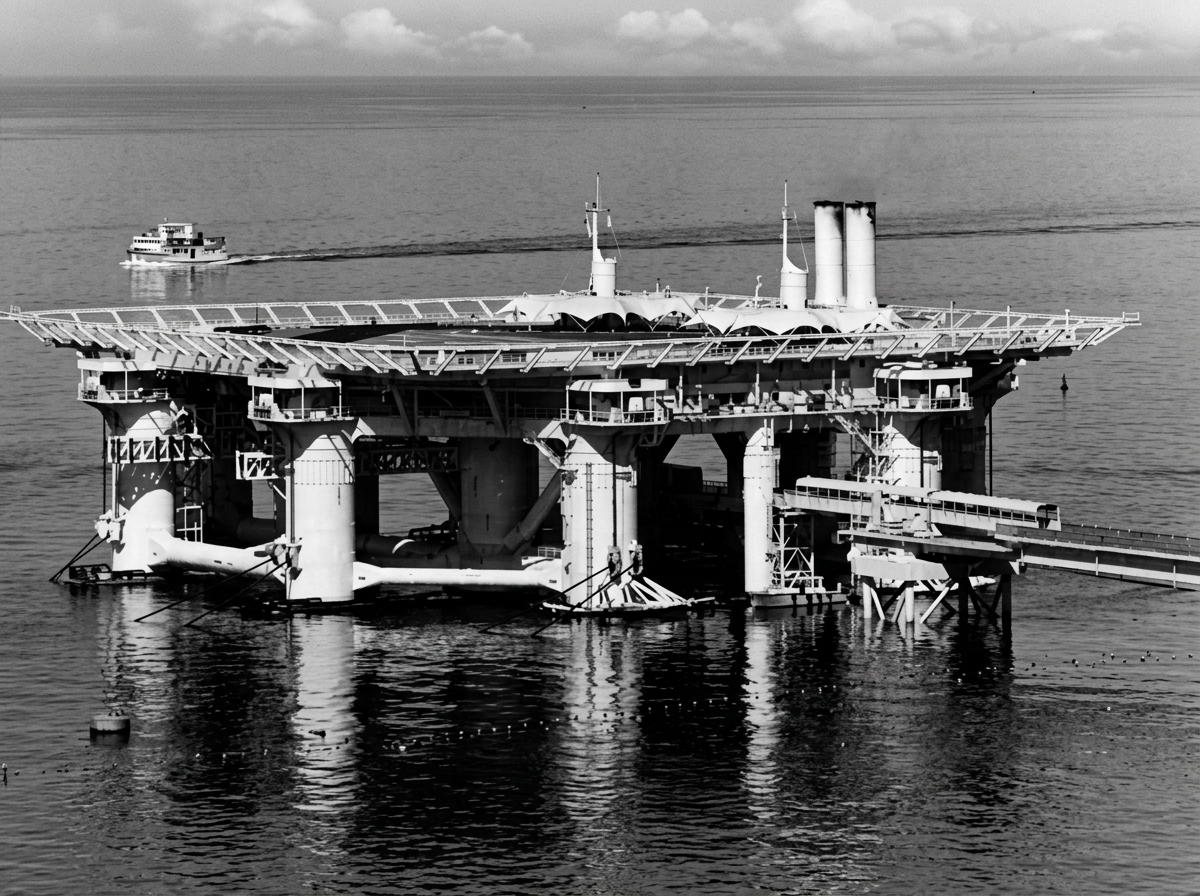
Image: Aquapolis at Okinawa
The ocean is a silent place, when it is being kind
Where only slapping stays tap out the pace of time
Where the motion of the ocean, is in a dancing line. - Thomas Goreau
28 september 2026Japanese names in this essay are given in Japanese order, family name first.
References
Aquapolis: A Small First Step toward a Future of Limitless Possibilities. Brochure. Floating Pavilion of the Government of Japan, International Ocean Exposition, Okinawa, 1975. Smithsonian Libraries. https://www.si.edu/object/siris_sil_999139.
Banham, Reyner. Megastructure: Urban Futures of the Recent Past. London: Thames and Hudson, 1976.
Blaxell, Vivian. "Preparing Okinawa for Reversion to Japan: The Okinawa International Ocean Exposition of 1975, the US Military and the Construction State." The Asia-Pacific Journal: Japan Focus 8, no. 29 (July 2010): e2. https://doi.org/10.1017/S1557466010010016.
Bureau International des Expositions. "Expo 1975 Okinawa." Accessed September 26, 2026. https://www.bie-paris.org/site/en/1975-okinawa.
Busan Metropolitan City. "MoU Signing Ceremony on Historic Initiative to Create Sustainable Floating Cities." November 25, 2021. https://www.busan.go.kr/eng/bsnews01/1512891.
Carroll, Jim. "The Kashmere Stage Band: Seeing the Future Inside of Us." Jim Carroll's Blog, July 24, 2025. https://www.jimcarrollsblog.com/blog/2025/7/24/the-kashmere-stage-band-seeing-the-future-inside-of-us.
Coral Reefs of the High Seas Coalition. "Priority Sites in the High Seas." Accessed September 26, 2026. https://www.coralreefshighseas.org/where-we-work.
"Creating a New Nation." Deep Sea Reporter. Accessed September 26, 2026. https://www.deepseareporter.com/creating-a-new-nation/.
"The First Falepili Union Visa Ballot: A Preliminary Assessment." Devpolicy Blog, Development Policy Centre, August 26, 2025. https://devpolicy.org/the-first-falepili-union-visa-ballot-a-preliminary-assessment-20250826/.
"The Future of Nakagin Capsule Tower: 23 Capsules Taken Out and Restored." Tokyo Art Beat. Accessed September 26, 2026. https://www.tokyoartbeat.com/en/articles/-/nakagin-capsule-tower-metabolism-news-en-202305.
Harvard Law School Environmental and Energy Law Program. "Deep Sea Mining." Regulatory tracker. Accessed September 27, 2026. https://eelp.law.harvard.edu/tracker/deep-sea-mining/.
Hilbertz, Wolf. "Toward Cybertecture." Progressive Architecture, May 1970.
Hirschman, Albert O. Exit, Voice, and Loyalty: Responses to Decline in Firms, Organizations, and States. Cambridge, MA: Harvard University Press, 1970.
"Houston Group Seeks Fresh Ideas for the Astrodome, Including a Data Center." CultureMap Houston, August 19, 2026. https://houston.culturemap.com/news/city-life/astrodome-conservancy-rfi-preservation-proposals/.
IndoCet Consortium. "Mapping Whales at the Saya de Malha Bank." Accessed September 26, 2026. https://indocet.org/en/mapping-whales-at-the-saya-de-malha-bank/.
Jacques Rougerie Database. "Autopia Ampere: Self Constructed City." Accessed September 26, 2026. https://www.jacquesrougeriedatabase.com/project/autopia-ampere.
Kashmere Stage Band. Expo. '75: Concert Tour Japan / Okinawa. LP. Houston: Kram Records, 1975. Reissued, Tokyo: P-Vine Records, 2025. https://kashmerestageband.bandcamp.com/album/expo-75-concert-tour-japan-okinawa.
"Kiyonori Kikutake, 1928–2011." The Architect's Newspaper, February 2012. https://www.archpaper.com/2012/02/kiyonori-kikutake-1928-2011/.
Koselleck, Reinhart. Futures Past: On the Semantics of Historical Time. Translated by Keith Tribe. Cambridge, MA: MIT Press, 1985. First published as Vergangene Zukunft (Frankfurt am Main: Suhrkamp, 1979).
Lamont, Shaun. Conversation with the author. September 28, 2026.
"A Look at OCEANIX Busan, the World's First Prototype of a Floating, Sustainable City." Outlook Traveller. Accessed September 26, 2026. https://www.outlookindia.com/travel/a-look-at-oceanix-busan-the-world-s-first-prototype-of-a-floating-sustainable-city-news-194533.
Matsuyama Zensō, dir. Okinawa Kaiyōhaku. 1976.
"Michael Oliver Republic of Minerva: How Tonga Thwarted a New Libertarian Nation." Slate, May 2022. https://slate.com/news-and-politics/2022/05/michael-oliver-republic-of-minerva-history-libertarian-micronations-tonga.html.
National Trust for Historic Preservation. "The Astrodome." Accessed September 26, 2026. https://savingplaces.org/places/the-astrodome.
"OTC at 50: Bold Vision Led to Unimagined Success." Journal of Petroleum Technology. Accessed September 26, 2026. https://jpt.spe.org/otc-50-bold-vision-led-unimagined-success.
Pendle, George. "New Foundlands." Cabinet, no. 18 (Summer 2005). https://www.cabinetmagazine.org/issues/18/newfoundlands.php.
"Saya de Malha Bank: Robbing a Bank When No One's Looking." Daily Maverick, March 28, 2025. https://www.dailymaverick.co.za/article/2025-03-28-robbing-a-bank-when-no-ones-looking/.
"The Queen & the Republic of Minerva." Queen of the Isles. Accessed September 28, 2026. http://www.queenoftheisles.com/HTML/Republic%20of%20Minerva.html.
The Seasteading Institute. "ClubStead Design." Accessed September 26, 2026. https://www.seasteading.org/clubstead-design/.
"Serbia, Mauritius Bring Artemis Accords to 70." SpacePolicyOnline.com, July 2026. https://spacepolicyonline.com/news/serbia-mauritius-bring-artemis-accords-to-70/.
"Statehood in the Climate Crisis: The ICJ's Climate Advisory Opinion and the Presumption of State Continuity." Climate Law Blog, Sabin Center for Climate Change Law, August 21, 2025. https://blogs.law.columbia.edu/climatechange/2025/08/21/statehood-in-the-climate-crisis-the-icjs-climate-advisory-opinion-and-the-presumption-of-state-continuity/.
Texas Parks and Wildlife Department. "Rigs-to-Reefs." Texas Artificial Reef Program. Accessed September 26, 2026. https://tpwd.texas.gov/landwater/water/habitats/artificial_reef/rigs-to-reefs.phtml.
Tokyo Foundation for Policy Research. "Forum Report: Land Rights and Responsibilities in the Twenty-First Century." Accessed September 27, 2026. https://www.tokyofoundation.org/research/detail.php?id=680.
United Nations Office for Outer Space Affairs. "Treaty on Principles Governing the Activities of States in the Exploration and Use of Outer Space, including the Moon and Other Celestial Bodies." 1967. https://www.unoosa.org/oosa/en/ourwork/spacelaw/treaties/outerspacetreaty.html.
United Nations, Division for Ocean Affairs and the Law of the Sea. "The United Nations Convention on the Law of the Sea (A Historical Perspective)." Accessed September 26, 2026. https://www.un.org/depts/los/convention_agreements/convention_historical_perspective.htm.
United Nations. "With Highest Annual Sea Level Increase Recorded, States Approve Declaration Calling for Urgent Action to Address Existential Threat." Meetings Coverage and Press Releases, SEA/2254, September 2026. https://press.un.org/en/2026/sea2254.doc.htm.
University of Texas at Austin School of Architecture. "Work by Former Professor Wolf Hilbertz at the MoMA." Accessed September 26, 2026. https://soa.utexas.edu/news/work-former-professor-wolf-hilbertz-moma.
Footnotes
1 The USSR Pavilion included the world’s largest-scale map of the ocean. Another memorable pavilion was the United States, which showcased past, present and future technologies, including a demonstration of an ocean thermal power plant, and ongoing research on air-sea interactions.
2 A portmanteau of cybernetics and architecture.